Does GoCardless re-present a failed Direct Debit automatically?
GoCardless reports whether each collection succeeded or failed, and it offers its own retry settings that can re-present some failures for you. That covers the routine case: a payment that failed on a Monday because the account was briefly short of funds and clears on a retry a few days later.
It does not cover everything. A collection whose retries are exhausted, one taken against a mandate that is no longer valid, or one where retries were never switched on, simply fails and stays failed. GoCardless does not, on its own, surface that lost collection as a prioritised recovery task tied back to the customer and the contract it belongs to. Until someone reconciles the payments against the invoices they were meant to settle, the shortfall sits in the gap between your bank collection system and your ledger.
Why a Direct Debit collection fails
A failed collection is rarely fraud and rarely the customer choosing to leave. It is usually one of a handful of ordinary reasons, and each needs a different response from your team.
- Insufficient funds in the customer's account on the collection date
- The mandate was cancelled by the customer or their bank, so a submitted collection is rejected
- The bank account was closed, or the account details changed
- The payment was disputed, or an indemnity claim was raised under the Direct Debit Guarantee
- Automatic retries were exhausted, or were never switched on
- A mandate that lapsed and produced no collection at all, which shows up as an invoice that was never settled rather than as a failure
How to find failed Direct Debits in GoCardless manually
You can find failed Direct Debits in GoCardless without any third-party tool, read-only, using the dashboard and a spreadsheet. Here is the manual pass.
- 1In the GoCardless dashboard, open Payments and filter by status. Select the failed status, and check cancelled and charged-back as well, since a charged-back collection is money that left your account again.
- 2Set the date range to the period you want to check, for example the last full month or quarter, and export the filtered list to CSV so you can work in a spreadsheet.
- 3For each failed collection, note the amount and the payment reference, then check the payment timeline or your retry settings to see whether GoCardless re-presented it and whether that retry succeeded.
- 4Match each failure back to the invoice it was meant to settle in your accounting or billing system. A failure that was re-presented and collected needs no action; a failure that was never re-presented, or whose retries all failed, is uncollected revenue.
- 5Separately, review your active mandates against your expected billing cadence. A customer you bill monthly who has produced no collection this month may have a mandate that has lapsed or been cancelled, which no failed-payment filter will show you.
- 6Add up the uncollected failures. That total is money you have earned, invoiced, and not been paid, waiting on a re-presentation or a call to the customer.
How do I spot a mandate that has lapsed?
A mandate that lapses quietly is harder to catch than a failed collection, because nothing fails. No collection is created, so no failure event appears in GoCardless, and a filter on failed payments will never show it.
You catch it from the other side, in the ledger. An invoice that should have been collected on its usual cadence, monthly or quarterly, and was not, is the signal that a mandate may have lapsed or been cancelled. This is why mandate and renewal risk is a question about your billing cadence in your accounting or billing system, not one you can answer from GoCardless payment data alone. LeakIQ infers that risk from the billing cadence in the connected accounting or billing system rather than from GoCardless directly.
What failed Direct Debits cost, and why involuntary churn matters
The reason failed Direct Debits deserve a standing check, not an occasional one, is that they are a leading cause of involuntary churn: revenue lost to a payment that failed rather than a customer who decided to leave.
of UK Direct Debit payments fail (GoCardless, across 55,000 businesses and 52 million transactions)
of customer churn is involuntary, a payment that failed rather than a customer who chose to leave (GoCardless)
of revenue commonly leaks away undetected, a widely cited industry estimate
Direct Debit failure and involuntary-churn figures: GoCardless, across 55,000 businesses and 52 million transactions. The 1% to 3% range is a commonly cited industry estimate, not a single published figure. See what revenue leakage is for the full context.
How LeakIQ surfaces failed Direct Debits automatically
Connect GoCardless to LeakIQ read-only and it reads your collections and flags the ones whose status is failed or declined as a failed Direct Debit, with the real amount and the source record attached, so your team can verify it against the ledger and decide whether to re-present the collection or contact the customer.
LeakIQ is read-only throughout. It never re-presents or re-submits a Direct Debit, never sets up a retry, never writes to GoCardless, and never moves money. Re-presenting the collection, and chasing the customer, are steps your team carries out in your own systems. LeakIQ also does not send a failed-payment notice on your behalf.
One honest limitation is worth stating plainly. GoCardless records do not carry a customer name, so LeakIQ cannot automatically confirm that a later re-presentation succeeded the way it can for recovered card failures. Rather than clear a flag it cannot verify, it deliberately leaves the failed collection flagged until your team confirms the outcome. For the same reason, GoCardless payments do not feed the duplicate-charge, at-risk-renewal or unapplied-cash checks, which group by customer; those run on your accounting and billing data instead.
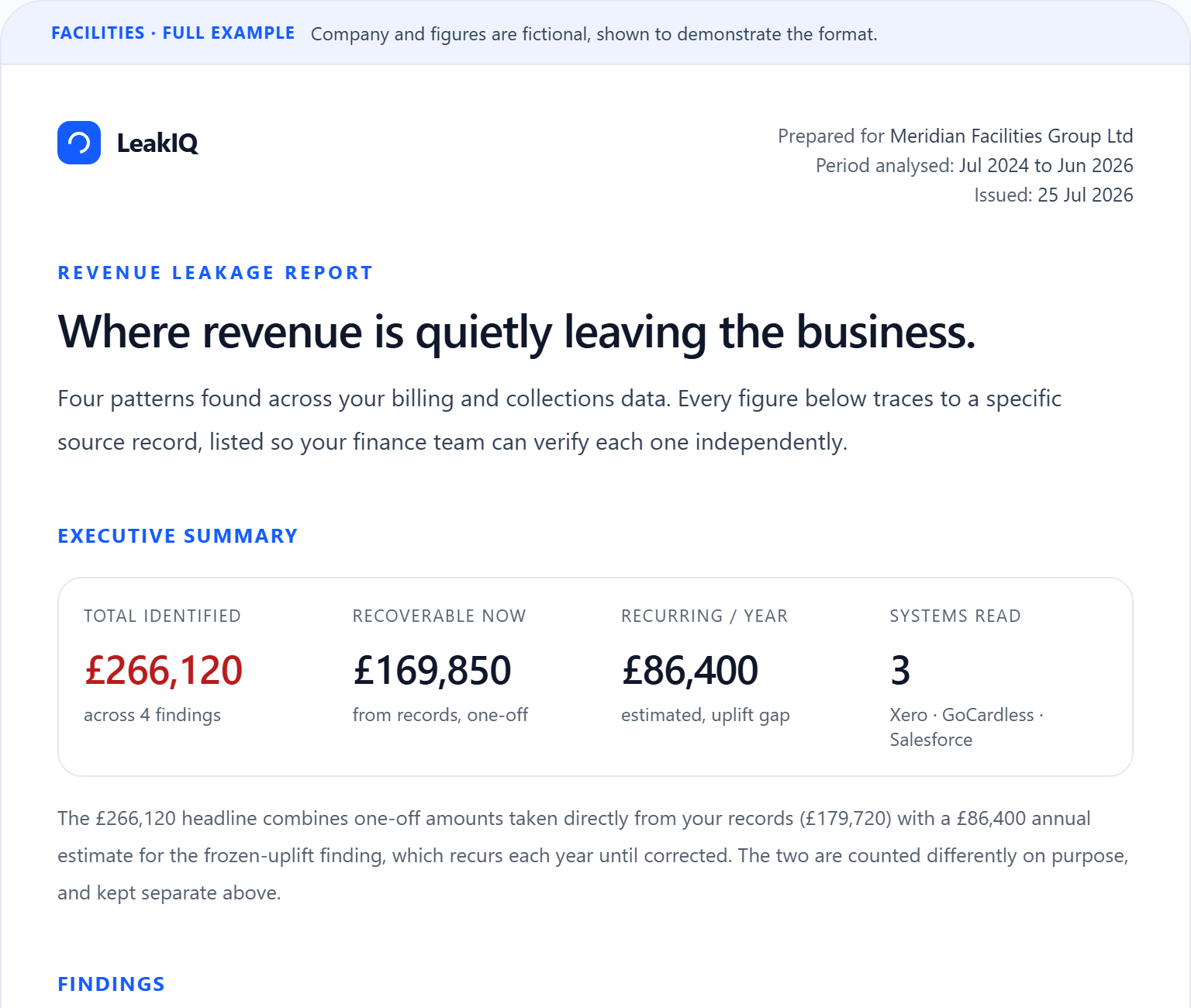
Want to see an example of the free report you'd receive?
The headline figures, then every finding with its amount, the customers affected and the source records behind it.
Common questions
How do I find failed Direct Debit payments in GoCardless?
In the GoCardless dashboard, open Payments and filter by the failed status, then export the list and match each failure back to the invoice it was meant to settle. The ones that matter are the failures GoCardless never re-presented, or whose retries all failed, because those are uncollected revenue rather than a payment that simply cleared a few days late. A read-only tool such as LeakIQ does the same scan automatically, flagging each failed collection with its amount and source record so you can verify it and decide whether to re-present or call the customer.
Does GoCardless retry a failed Direct Debit automatically?
GoCardless offers retry settings that can re-present some failures for you, which handles the common case of a payment that failed because the account was briefly short of funds. It does not recover everything: retries can be exhausted, never switched on, or taken against a mandate that is no longer valid, and those collections simply stay failed. It is the failures its retries do not recover that need a person to re-present the collection or contact the customer.
What is the difference between a failed Direct Debit and a lapsed mandate?
A failed Direct Debit is a collection that was attempted and rejected, so it appears in GoCardless with a failed status. A lapsed or cancelled mandate that produces no collection throws no failure event at all, so filtering failed payments will never surface it. You catch a lapsed mandate from the ledger instead: an invoice that should have been collected on its usual cadence and was not. That is why mandate risk is a question about your billing cadence in your accounting system, not one you can answer from GoCardless payment data alone.
How much revenue do failed Direct Debits and involuntary churn cost?
Finance teams commonly estimate that 1% to 3% of revenue leaks away undetected, and failed payments are a large part of it. In the UK around 2.9% of Direct Debit payments fail, measured by GoCardless across 55,000 businesses and 52 million transactions, and roughly 30% of customer churn is involuntary, a payment that failed rather than a customer who chose to leave. That makes a standing check on failed collections one of the highest-return reconciliation habits a finance team can build.
Does LeakIQ re-present or chase failed Direct Debits for me?
No. LeakIQ is read-only: it detects failed GoCardless collections and shows each one with its amount and source record, but it never re-presents the Direct Debit, sets up a retry, writes to GoCardless, or moves money, and it does not send a failed-payment notice. Re-presenting the collection and chasing the customer are steps your own team carries out in your own systems. Because GoCardless records carry no customer name, LeakIQ also cannot auto-confirm a later re-presentation succeeded, so it leaves the failure flagged until your team confirms the outcome rather than clearing it silently.
Keep reading
- the Stripe card payments guide
The same problem on card rails, where a failed charge that is never retried quietly becomes lost revenue.
- the involuntary churn guide
How failed payments across Direct Debit and card add up to churn you can win back.
- what revenue leakage is
A plain-English primer on the underlying problem before you go looking for it.
- an example leakage report
What a finished report of your own failed collections and other leakage looks like.
- the platform
How LeakIQ reads your systems read-only and turns findings into prioritised recovery tasks.