How do you tell involuntary churn from a customer who chose to leave?
Start from the payment event, not the customer's mood. There are two tells worth chasing. The first is a failed collection: a card payment that failed in Stripe, or a direct debit that failed in GoCardless, that was never followed by a successful one. The second is a broken billing rhythm: a customer you have billed regularly for months or years whose next invoice is overdue to appear, with no cancellation on record.
Both are recoverable far more often than a real cancellation, because nobody actually decided to leave. A failed charge that later succeeds is not lost revenue at all, it self-corrected, so any honest check has to set those aside. What is left, an unrecovered failure or a rhythm that simply stopped, is the population worth confirming. Neither signal knows the customer's intent, so treat each as a question to put to the account owner or the customer, not a conclusion that they have gone.
What your billing and payments systems do not tell you
Stripe and GoCardless both retry failed collections automatically and can send dunning reminders, and many failures recover that way. What none of these systems does is reconcile the residue against your ledger to tell you which story you are looking at. Left to the dashboard alone, the following stay invisible:
- That a failed charge on a still-active subscription is a customer you can win back, not one who left. Both look identical in the payments view.
- Whether retries and dunning have run their course, or the balance is simply being carried in someone's head as money that will turn up eventually.
- That a long-standing recurring customer has gone quiet: their invoices have stopped appearing, but nothing was ever cancelled.
- The pound value at risk if that lapse is real, sized against how often and how much that customer used to be billed.
- Which failures later self-corrected, so they should not be counted as lost at all.
How to find involuntary churn manually (read-only)
You can separate the two by hand, without writing to anything, using exports from your payment and billing systems. Set a review window, a quarter is a sensible start, and work through it in two passes.
- 1In Stripe, filter charges or payments to Failed over your window and export them. Note that most of these subscriptions still show as active.
- 2In GoCardless, pull the failed payments and failed mandates for the same window and export them alongside.
- 3For each failed collection, check whether a later payment from the same customer succeeded. If it did, the failure self-recovered, so set it aside. If it did not, it is an unrecovered failure and a candidate for involuntary churn.
- 4Now the second pass. In your billing system, whether Xero, QuickBooks or Stripe invoices, list customers billed on a settled, regular cadence, say at least three invoices running anywhere from monthly through to annually.
- 5For each, check whether the next invoice appeared roughly on schedule. Flag any whose next invoice is overdue to appear by more than about one and a half billing cycles, but not so long that the customer is obviously long gone. That gap is a renewal that may have lapsed with nobody cancelling.
- 6For every candidate from both passes, confirm intent with the account owner or the customer: did they mean to leave, or did the collection simply fail? Size the recoverable amount on the annual value of the recurring billing, because that is the largest thing at stake.
How big is involuntary churn?
The reason this is worth the effort is that involuntary churn is a large, quiet share of what finance teams write off as lost customers.
of customer churn is involuntary, a payment that failed rather than a customer who chose to leave
of UK Direct Debit payments fail
of revenue commonly leaks away undetected
Direct Debit failure and involuntary-churn figures: GoCardless, measured across 55,000 businesses and 52 million transactions. The 1% to 3% range is a commonly cited industry estimate, not a single published figure.
How LeakIQ surfaces involuntary churn automatically
LeakIQ does the same two passes for you, read-only. It connects to Stripe and GoCardless through native read-only connectors and flags the failed collections that were never recovered: failed card payments and failed direct debits with no later success against them. A payment that later goes through auto-suppresses the earlier failure, so a charge that failed on Tuesday and cleared on Friday never reaches your queue.
For the went-quiet case, it reads your invoice history from Xero, QuickBooks or Stripe and looks for a customer billed on an established, regular cadence, at least three invoices from monthly to annual, whose next invoice is overdue to appear by more than one and a half cycles but not so long they are plainly gone. That renewal signal is inferred, so LeakIQ scores it lower on its deterministic confidence scale and labels it as inferred, and it is measured against the horizon of the data you gave it, so a stale export does not read as a wave of false churn. Severity is sized on the annualised recurring exposure, because recurring revenue is the largest recoverable class.
Crucially, LeakIQ flags the risk and routes it to an owner to act on. It never retries the failed payment, never re-presents the direct debit, never re-issues the lapsed invoice or re-contracts, and never moves money. It does not send win-back or failed-payment emails, and it does not decide that the customer has churned. It asserts that a payment failed or that a billing rhythm broke, and leaves your team to confirm intent and carry out the recovery in your own systems. Other billing and payment systems can be brought in through a CSV or JSON export.
Want to see an example of the free report you'd receive?
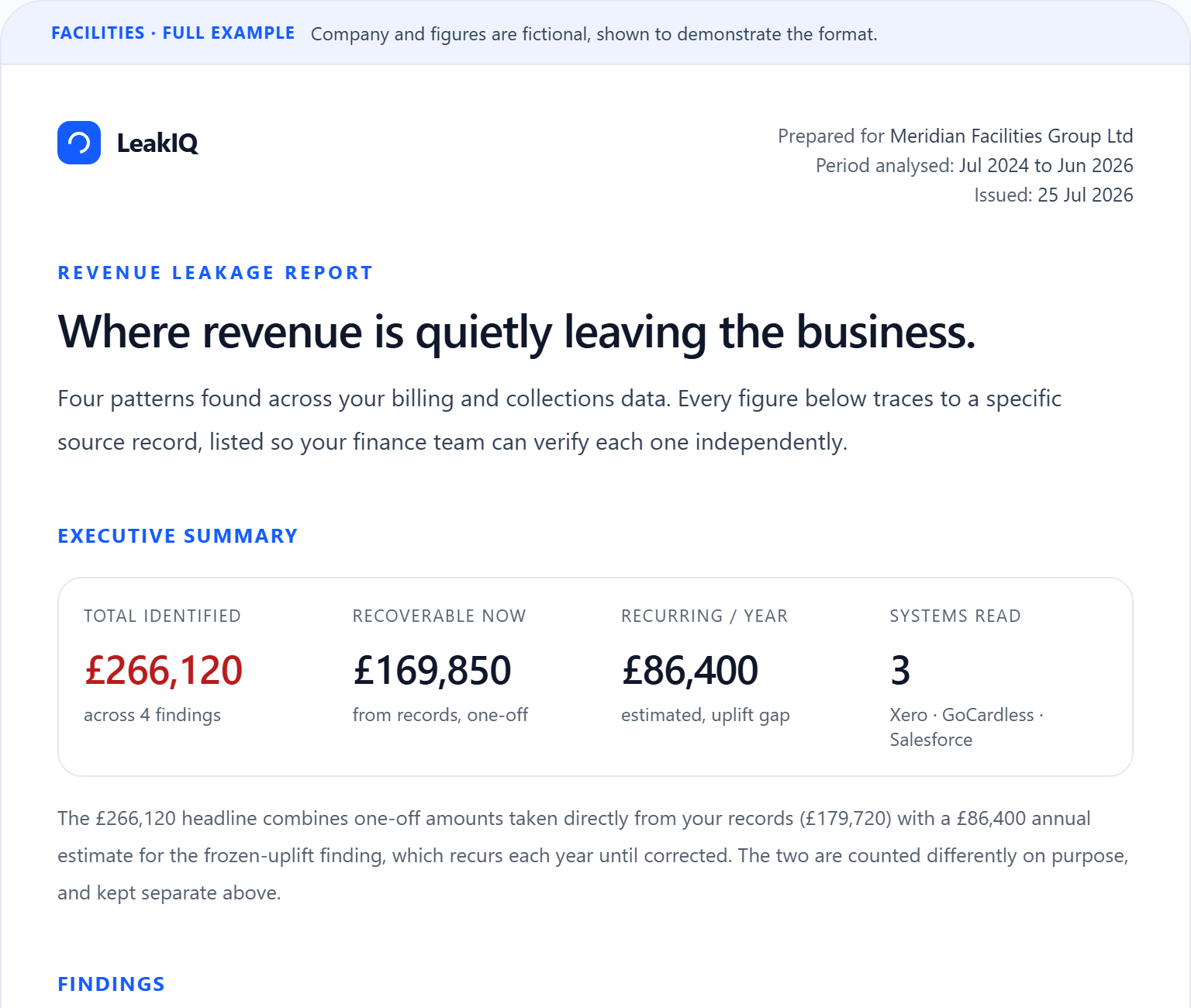
The headline figures, then every finding with its amount, the customers affected and the source records behind it.
Common questions
What is involuntary churn?
Involuntary churn is subscription or contract revenue you lose because a payment failed, not because the customer decided to leave. In practice it is a failed card charge or a failed direct debit that was never recovered, sitting behind a subscription that still shows as active. It is worth separating from voluntary churn because nobody actually chose to go, which means the revenue is often recoverable if you catch it in time.
Does Stripe or GoCardless already recover failed payments for me?
Partly. Both Stripe and GoCardless can automatically retry a failed collection and send dunning reminders, and many failures do recover that way. What neither does is tell you whether the revenue still lost after those retries is recoverable involuntary churn or a customer who genuinely chose to leave, and neither watches for a long-standing recurring customer whose invoices have simply stopped appearing. Separating those needs a cross-check between your payment records and your billing history.
How do I know a customer's subscription lapsed rather than they cancelled?
If there is no cancellation on record but the invoices you used to send every month or quarter have stopped appearing, the renewal may have lapsed by accident rather than by choice. A practical test is whether the next invoice is overdue to appear by more than about one and a half billing cycles, while not being so overdue that the customer is plainly long gone. Even then it is a question to confirm with the account owner or the customer, not a conclusion, because the data shows a broken rhythm, not intent.
How much of my churn is really involuntary?
GoCardless, measuring across 55,000 businesses and 52 million transactions, puts roughly 30% of customer churn as involuntary, a payment that failed rather than a customer who chose to leave. On the same dataset, around 2.9% of UK Direct Debit payments fail. Finance teams also commonly estimate that 1% to 3% of revenue leaks away undetected, of which failed collections are a meaningful part.
Does LeakIQ chase or retry the failed payment for me?
No. LeakIQ is read-only: it detects the unrecovered failure or the lapsed renewal, attaches the source record, and routes the at-risk revenue to an owner, but it never retries a card payment, re-presents a direct debit, re-issues an invoice, sends a win-back email, or moves money. The recovery is carried out by your team in your own billing and payments systems. That is deliberate, so nothing LeakIQ does can touch your ledger or your customers without a person deciding to act.
Keep reading
- the Stripe card payments guide
the card side of the same problem, failed charges in Stripe
- the GoCardless guide
failed direct debits, the other half of the failed-collection signal
- what revenue leakage is
the plain-English primer on the wider problem
- an example leakage report
what the findings look like on real numbers
- how the platform works
how LeakIQ reads your systems read-only, end to end