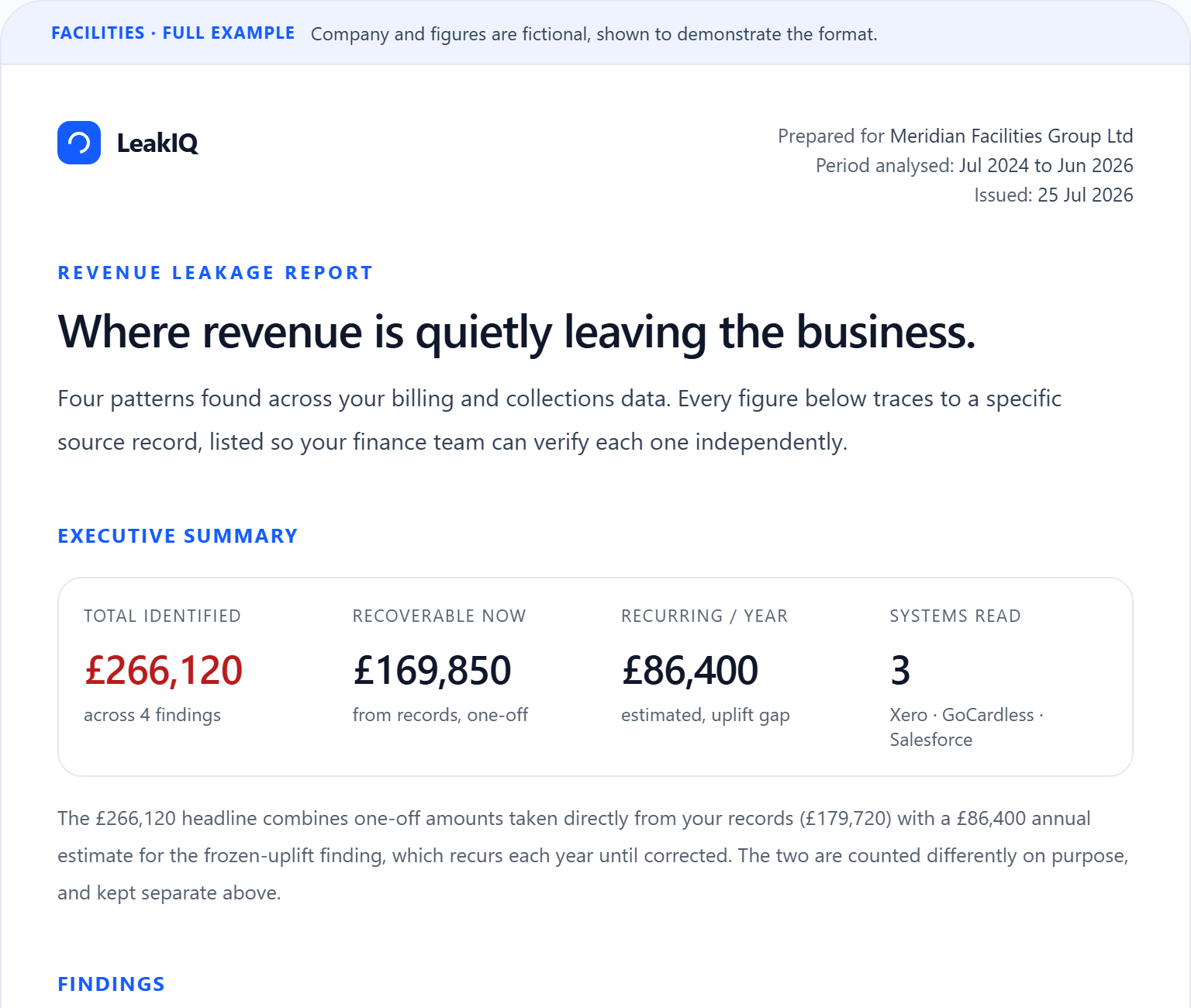
Where it leaks
Failed Direct Debits while supply continues
A Direct Debit bounces on the due date and the supply keeps running regardless, so the charge sits uncollected rather than appearing as a service you stopped providing.
An uplift that reached one customer book and not another
An agreed tariff change or contractual indexation is applied to some accounts and missed on others, and every invoice since has looked perfectly normal at last year's rate.
Supply points that stopped being billed
After a change of tenancy, a meter exchange or a migration, a recurring charge simply ceases while the supply stays live, leaving months of unbilled revenue on an account nobody is querying.
Standing charges and ancillary fees not raised
The consumption element invoices correctly but the recurring standing charge, reconnection fee or ancillary line is missing, so each invoice is short by a small, consistent amount.
Duplicate billing across migrations
The same period is invoiced twice where billing cycles overlap or an account is moved between systems, which becomes a credit you hand back later rather than revenue you keep.
Credits raised in dispute and never re-billed
A query is settled with a credit note while the underlying charge is resolved in your favour, and nobody re-raises it, so the account stays permanently short.
The scale
Across industries it is commonly estimated that 1% to 3% of revenue leaks before it reaches the bank, and GoCardless has observed that roughly 2.9% of Direct Debit payments fail across about 55,000 businesses. Utilities carry an unusually high share of Direct Debit collection, so that failure rate lands on a larger base than in most sectors. As an illustration only, on a utility business turning over £50m a year, 1% to 3% is roughly £500k to £1.5m.
How it is found
LeakIQ reads your own billing, payment and ledger data read-only, with no change to any system, and needs no rollout before the leaks surface.
Take the full guide with you
If you would like your own figure, we can show you for free what your finance data reveals, with no obligation.
Common questions
We already run billing validation and exception reports. What would this add?
Billing validation confirms that the invoices you raised were calculated correctly. It is far weaker on the invoice that was never raised at all: a supply point that quietly stopped billing, a standing charge missing from an otherwise correct bill, or an uplift that reached most of the book and not the rest. LeakIQ reads the finance data itself and flags where earned money never arrived, independent of the system that produced the bill.
Does this reconcile consumption against settlement or meter data?
No, and it is worth being plain about that. LeakIQ reads invoices, payments and ledger entries from systems like Xero, QuickBooks, Stripe and GoCardless, and compares each account's billing against its own history. Under-recovery that only shows up by reconciling metered volumes against settlement or against your rating and billing engine is outside what it can see today.
Is it safe to connect our finance systems?
The connection is read-only, so nothing in your billing or ledger is changed. LeakIQ only reads the records it needs to spot leakage and reports back what it finds.
How is this different from an aged debtors report or a Power BI or Tableau dashboard?
An aged debtors report, or a dashboard in Power BI or Tableau, shows what is already on your ledger: invoices you raised that have not been paid. Revenue leakage is the money that never reached the ledger correctly in the first place, under-billed, never invoiced, or failed on collection and never chased, so it usually never appears on a debtors report at all. That is what this audit looks for.
Keep reading
- What revenue leakage is
The plain definition, and why earned revenue slips before the bank.
- Revenue leakage in every other sector
The same field guide for facilities, waste, logistics, security and more.