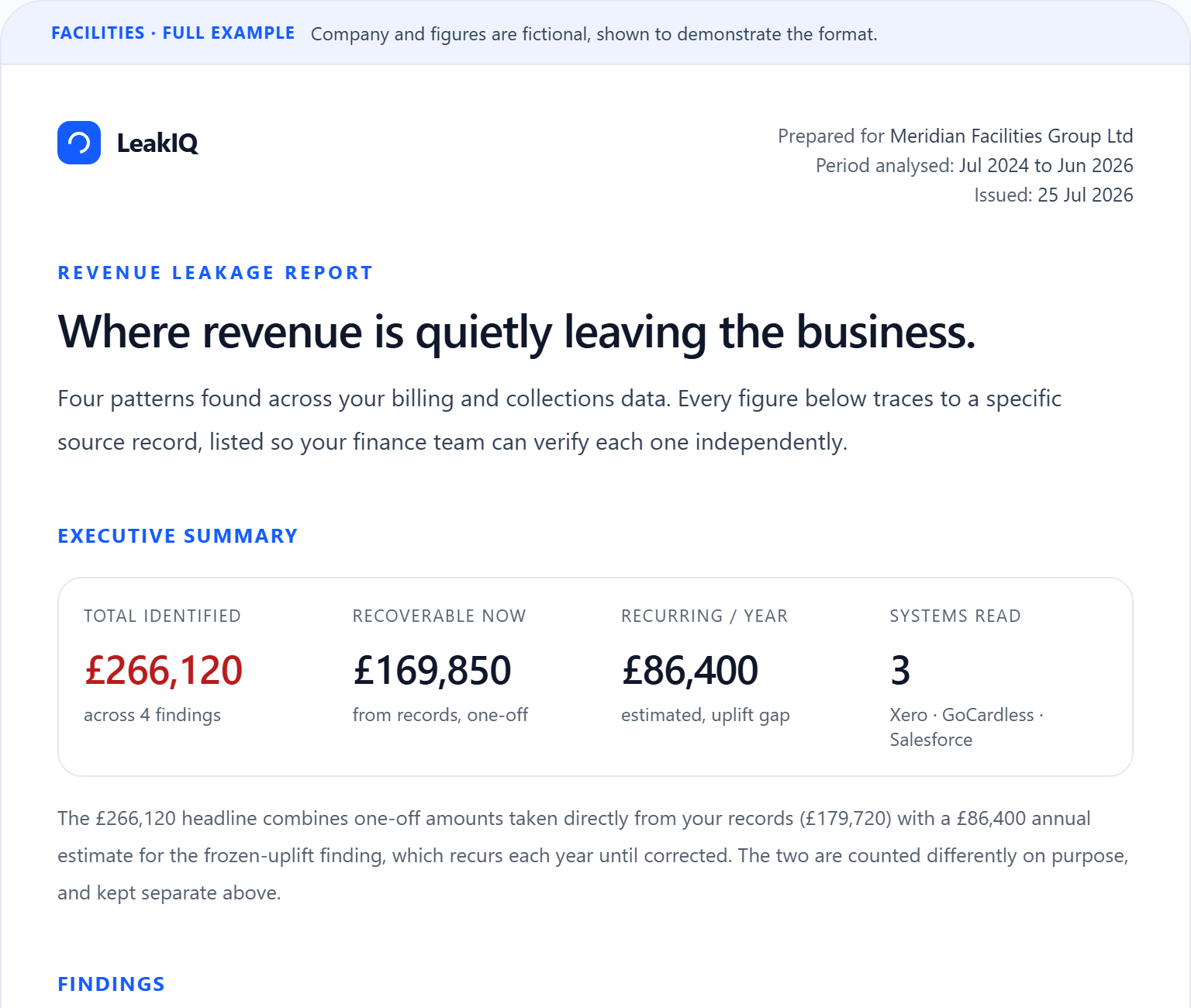
Where it leaks
Failed payments and Direct Debits
Collections that fail at the bank and are never re-presented or chased, so an invoice that was correct is simply never paid.
A price that quietly stopped moving
Work carries on and the invoice carries on, but the price stopped tracking what was agreed, so every invoice after that point is raised short.
A recurring charge that quietly stopped
A regular subscription or service line drops off the billing run after a change or migration, and nobody notices the charge has ceased.
Duplicate charges and credit-note errors
The same item billed twice, or a credit note issued and never applied, or applied twice, quietly distorting the balance.
Short payments left unchased
Customers pay slightly under the invoiced amount, and the small shortfall is written off in practice rather than recovered.
Rounding and FX slips
Small rounding differences and foreign-exchange slips on cross-border invoices, immaterial one by one but adding up across a large ledger.
The scale
It is commonly estimated that around 1% to 3% of revenue leaks before it is collected. Payment failure is a real part of it: GoCardless has observed that roughly 2.9% of Direct Debit payments fail, across about 55,000 businesses. As an illustration only, on a business turning over £20m, 1% to 3% is roughly £200k to £600k a year.
How it is found
It is found by reading your own finance data read-only, from the systems you already use, with no change to any of them, and with no implementation to sit through first.
Take the full guide with you
If it helps, you can get your own leakage number for free and simply see what, if anything, is slipping through.
Common questions
Does this only work for certain industries?
No. It works from the money itself, invoices, payments, credit notes and bank and ledger records, so any business that bills and collects can be checked. The signal is a customer's billing drifting away from its own history, which is universal.
How is this different from our monthly finance review?
A monthly review checks that the books balance, not whether every job that was done was actually billed and collected. Leakage detection compares each customer's billing against its own history and payment record to flag the charges that quietly went missing.
Do you need access to our operational systems?
No. It reads finance data only, on a read-only basis, so nothing in your live billing or operations changes. Because it is a read rather than an implementation, the time to a first view is really just the time it takes to get us the data.
How is this different from an aged debtors report or a Power BI or Tableau dashboard?
An aged debtors report, or a dashboard in Power BI or Tableau, shows what is already on your ledger: invoices you raised that have not been paid. Revenue leakage is the money that never reached the ledger correctly in the first place, under-billed, never invoiced, or failed on collection and never chased, so it usually never appears on a debtors report at all. That is what this audit looks for.
Keep reading
- What revenue leakage is
The plain definition, and why earned revenue slips before the bank.